
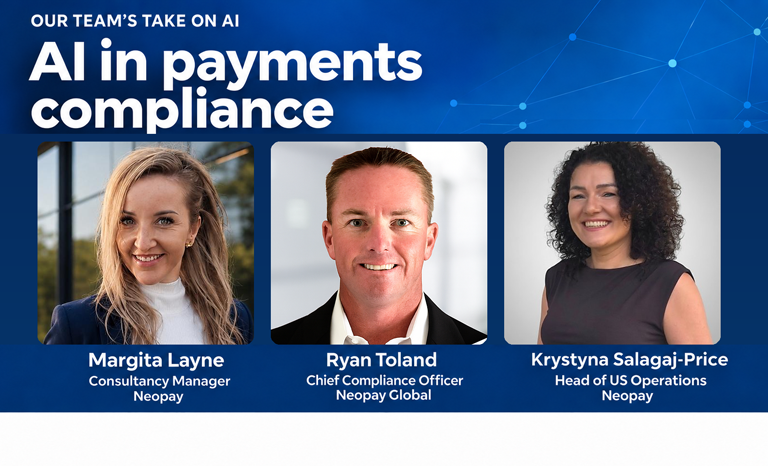
Colleagues from Neopay and Neopay Global share their thoughts on AI in payments compliance, its practical uses and the checks that help firms get the most from it.
From admin tasks, such as meeting notes or recaps, to more complex areas such as due diligence or transaction monitoring, there are plenty of ways AI can help payment and e-money firms. We asked Margita, Ryan and Krystyna to take a closer look at where it can be useful, what needs care and how its use might develop. Here, they share their experiences and views in a conversational Q&A.
Meet the team
Margita Layne, Consultancy Manager, Neopay
Ryan Toland, Chief Compliance Officer, Neopay Global
Krystyna Salagaj-Price, Head of US Operations, Neopay
Where are firms using AI in compliance?
Margita: The obvious ones people think of are due diligence, fraud, transaction monitoring and reconciliations. The key is to make sure the source data is appropriate and the system is tailored and calibrated to your business. That needs ongoing review and regular testing – not just when there are changes.
What about the less obvious ones?
Margita: Recording meetings, generating summaries or improving communications – these can be useful. Well-structured meeting minutes help strengthen governance and evidence your controls, reviews and processes. The key is to check any AI-generated emails, transcripts or notes before using or sharing them, to avoid errors or misinterpretation.
Ryan: Reporting – pulling together data and reports – or just improving the presentation of reports and graphs. You need to make sure you know what data and what reports you need. They should be defined from your risk assessments and other policies and procedures – you need to make sure you’re producing what’s actually needed.
Margita: I’d add to that only to use it if it actually helps. You can end up spending more time configuring tools or producing reports and analysis than you would have otherwise. Sometimes a more bespoke approach to reporting on that particular area may save time and provide better results.
Krystyna: Another area is using AI to draft policies and procedures. In the AI-generated documents we’ve reviewed, there were gaps that needed further work to meet review requirements. AI could help identify gaps or draft missing sections if it has the right information. But the content still needs checking by someone with relevant experience to make sure it is complete and compliant with the regulatory requirements.
Ryan: But using it to align the presentation across document packs or improve readability can work, so long as you’re prepared to check it carefully afterwards.
Margita: I’d also be careful when using AI to summarise complex regulatory updates or audit reports. It can give you a starting point, but it may simplify things too much or miss the wider context. You still need to check the summary against the original and make sure the important detail hasn’t been lost.
What about in areas like customer service and vulnerable customers?
Krystyna: AI can be a valuable tool in customer service. Some platforms use it to help create email templates and categorise emails based on the content. That can be useful when handling complaints or disputes. Agents still need to personalise each email and check that it accurately reflects the customer’s case. Alongside other automated features, it can help teams include the wording they need, route emails to the right people and set up reminders or escalations when responses are missed.
Ryan: You can also use AI to help evaluate your communications, complaints and quality assurance data to look for trends and highlight potential weaknesses and improvements.
Margita: When it comes to customers who may need extra support, I think it’s worth remembering that some people prefer digital tools or would rather avoid having to chat with another person. Making sure they can easily speak to a real person if they need to may work better than assuming everyone wants the same approach. It comes back to having oversight of AI-driven solutions and understanding how they affect customers.
Ryan: Staff training is still really important here. Where a person is making decisions, they need to understand the range of challenges and difficulties different customers may have, and know when extra support is needed.
Krystyna: Testing is important too. For each project, you need to work through the different scenarios to check that the system operates as intended. That includes checking that assignments and tagging work correctly, and that reminders are triggered at the right times. Testing can show you where further adjustments are needed.
What are the risks firms should be aware of?
Ryan: One of the most talked-about risks is “hallucinations”. Basically, AI can produce an answer that sounds convincing but isn’t accurate. That can include quoting regulations or procedures that don’t exist, so it’s important to check the output.
Margita: There’s also the question of understanding how a system reaches its decisions. That isn’t always straightforward. Again, correct configuration, calibration, testing and oversight are important. You need enough understanding of the tool to assess whether it’s doing what you need it to do.
Krystyna: There are external risks as well: Synthetic identities and deepfakes to fool onboarding and decision-making systems; cyber threats; even fraud and financial crime risks no one’s considered yet.
Margita: And firms need to decide how they will deal with AI agents acting for their customers. What processes and procedures do they need to mitigate the new risks from these tools?
Ryan: There’s also the question of expertise. Finding people with both compliance experience and an understanding of AI can be difficult. Keeping up with developments and emerging risks takes time, so firms need to think about how they’ll support the people doing that work.
Krystyna: AI is changing how some risks develop. That makes it important to have people responsible for managing each area, rather than relying entirely on AI tools.
How do you see your use of AI changing in the future?
Margita: The technology keeps developing, so some of the limitations we see now may change. It’s about understanding the tools you’re using and having controls in place to make sure they work in a way that helps customers, suppliers, employees and the firm itself.
Ryan: How customers use AI will have a big impact too. What expectations will customers have in the future? It could be more AI agents acting for them, using AI to write communications and complaints – in theory this could simplify a lot of processes for people, but you still have to consider those who are less comfortable with new technologies and not very digitally literate. Are firms going to need different processes for AI and non-AI customers?
Krystyna: Scam and fraud exposure is a big area. As new threats develop, AI could also help firms develop protections and respond more quickly.
Ryan: AI does make some programming much quicker and easier – that should help speed up innovations in our market. And potentially help develop solutions that don’t seem possible at the moment.
It could also help suggest new ideas by analysing customer and business data. Those ideas would still need checking and developing, but there’s potential to find useful opportunities that might otherwise be missed.
Final thoughts
AI has useful applications across payments compliance and customer service. The discussion comes back to understanding what a tool can do, configuring it for the business and checking how it performs. Staff training and experienced judgement remain important as firms explore new uses.
How Neopay and Neopay Global can help
If you’re reviewing how AI fits into your compliance processes, Neopay and Neopay Global can help you assess the risks and review the controls around its use. Through compliance advice, independent reviews and staff training, our teams support payment and e-money firms in the UK, US, Canada and Europe.
Contact Neopay or Neopay Global to discuss the support your business needs.