AML fines often dominate headlines, with regulators across the globe issuing increasingly large penalties for failures in financial crime controls. But while these figures attract attention, they rarely tell the full story.
In reality, AML failures have consequences beyond financial penalties. Firms often face operational disruption, heightened regulatory scrutiny, and lasting damage to reputation and business relationships.
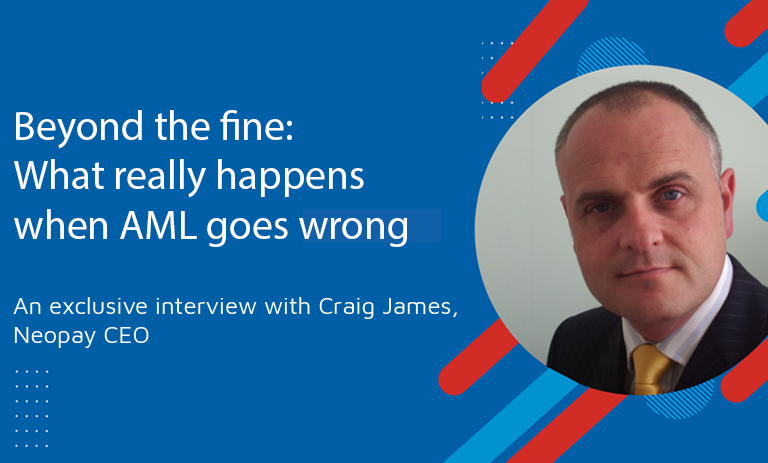
To understand the real impact of AML failures, we spoke with Craig James, CEO of Neopay. With over 20 years of experience in payments and e-money, including senior compliance roles, Craig has supported European and international firms in growth, regulatory compliance, and market expansion.
In this interview, he discusses the key risks firms face, why AML failures persist, and the steps businesses should take to prevent them.
AML fines tend to grab the headlines, but are they the biggest risk firms should be worried about?
The fine itself has potentially significant financial implications beyond the initial impact on the balance sheet, such as increased insurance premiums, loss of personnel and the associated replacement costs.
However, there is a much bigger risk that comes with it. Firms can find themselves under ongoing regulatory supervision, while also dealing with the operational cost of continuing to do business and ‘repairing’ the business at the same time. This is often coupled with reputational damage and a loss of customer and supplier confidence, which can lead to reduced revenue, increased supplier costs, or even the removal or restriction of services by suppliers.
There is also what could be described as a “domino effect”. If a firm operates internationally and holds licences in other jurisdictions, it may face scrutiny from regulators in those regions as well. We have seen cases where regulatory action in the US has led the FCA to impose sanctions on a UK firm simply because they are part of the same group and share UBOs or senior management.
What does regulatory intervention actually look like in practice when AML issues are identified?
Regulatory intervention can take many different forms, depending on the seriousness of the issues identified.
The best way to think about it is as a disruptive event. It will typically involve a time-consuming and resource-intensive process, with reviews carried out either by the regulator or appointed auditors, often at significant cost.
In a best-case scenario, a firm may go through an extremely thorough audit. In other cases, firms may face restrictions, such as being prevented from onboarding new customers. In the worst-case scenario, a firm could be required to stop its activities altogether until the issues are fully remediated, or in extreme cases, have its licence revoked.
How disruptive can this be from an operational perspective for firms?
As I mentioned earlier, it very much depends on the extent and severity of the non-compliance, and the level of remediation required.
In some cases, the impact can be significant enough to force a firm to close. This is not theoretical, there have been a number of firms in both the UK and the US that have met this outcome in recent years.
Apart from operations, how can AML failures affect a firm’s reputation and business relationships?
Naturally, customers want to deal with reputable and safe payment providers. Any FCA warning or regulatory notice is generally a deterrent.
This can lead to customers taking their business elsewhere and a reduction in onboarding numbers. In addition, there are many forums where customers can share their views, which in itself can be damaging to a firm’s reputation.
Given how significant these impacts are, why do firms still get AML wrong?
Often, firms rely on doing the bare minimum, which is no longer enough. In many cases, the FCA’s expectations go beyond the basic requirements.
There are also legacy issues, with firms relying on policies and procedures written many years ago. Financial crime has evolved, and processes need to keep up with that change.
Another common mindset is “others do the same”, which does not hold up. What may appear the same externally is often very different in practice, and regardless, the FCA will not adjust its expectations based on what others may be doing.
A “deal with consequences later” approach is another key issue. Failing to resolve deficiencies quickly and effectively often leads to much bigger problems over time. Similarly, the idea that “it’s easier to ask forgiveness than get permission” may work internally, but it does not apply when dealing with regulators.
Finally, there can be a lack of experience to identify gaps and address them before they are picked up by auditors or regulators.
What are the most common weaknesses you notice when looking at firms’ AML frameworks?
A common issue is legacy documentation, where policies and procedures have not kept pace with regulatory changes and evolving requirements.
There is often a lack of detail around specific processes and internal controls, as well as customer risk assessments that are overly templated rather than accurately reflecting the firm’s business model and the risks posed by its customers and activities.
More broadly, firms may not fully understand or properly conduct their overall business risk assessments in relation to financial crime.
Transaction monitoring arrangements can also fall behind, particularly where firms are not keeping up with available technology, including developments in AI.
Another key issue is the lack of active cooperation between compliance and other departments. For example, IT teams may update or amend systems without involving compliance early enough, leading to non-compliant processes being implemented. Similarly, business development teams may agree client arrangements that conflict with regulatory requirements.
There are also gaps in training and awareness, meaning employees are not always up to date with regulatory or internal changes. This is often combined with weak governance arrangements and ineffective operation of the three lines of defence.
We have also noticed a growing issue around over-reliance on AI. Firms are increasingly using it to construct entire frameworks, but not always checking that the detail aligns with their specific requirements.
There have been examples of documents that reference US law in UK frameworks, and vice versa, as well as inconsistent spelling and poorly constructed sentences that do not clearly define or conclude actions. In some systems, the AI will populate the file/document properties with its identity. It is literally signing its own work and confirming to the Regulator that you used a template.
These issues suggest a lack of ownership and understanding of the framework, which regulators are likely to notice very quickly.
Finally, there is often insufficient compliance monitoring and oversight, meaning issues are not identified and addressed early, increasing the likelihood of regulatory intervention.
What practical steps should firms be taking now to avoid these kinds of issues?
Firms should be taking additional steps to ensure their financial crime frameworks are regularly assessed and reviewed by professionals.
They should move away from legacy documentation and ensure that all frameworks are fit for purpose and kept up to date.
It is also important to have appropriate arrangements in place for employee training and awareness, ensuring staff remain up to date with both regulatory expectations and internal processes.
Firms should follow regulatory guidance and seek input from industry experts and professional bodies, such as payments associations and compliance firms.
Finally, there should be active and documented engagement between compliance and all areas of the business. If individuals within the organisation are not aware of the compliance function, what it does, or its importance, then the firm is, by definition, too exposed to risk.
What firms should do next
AML failures are often seen as financial penalties, but as Craig notes, the real impact is deeper. Operational disruption, regulatory scrutiny, and reputational damage can have lasting effects beyond the initial fine.
For firms in a complex and highly scrutinised environment, a proactive AML approach is essential. Frameworks must be effective, regularly reviewed, and aligned with evolving regulatory expectations to maintain compliance and commercial stability.
At Neopay, we partner with firms to assess, strengthen, and future-proof their AML and compliance frameworks. We help identify gaps early, prevent costly disruption, and support confident operations in a changing regulatory landscape.
If you would like to discuss your AML framework or need support, please contact the Neopay team.