

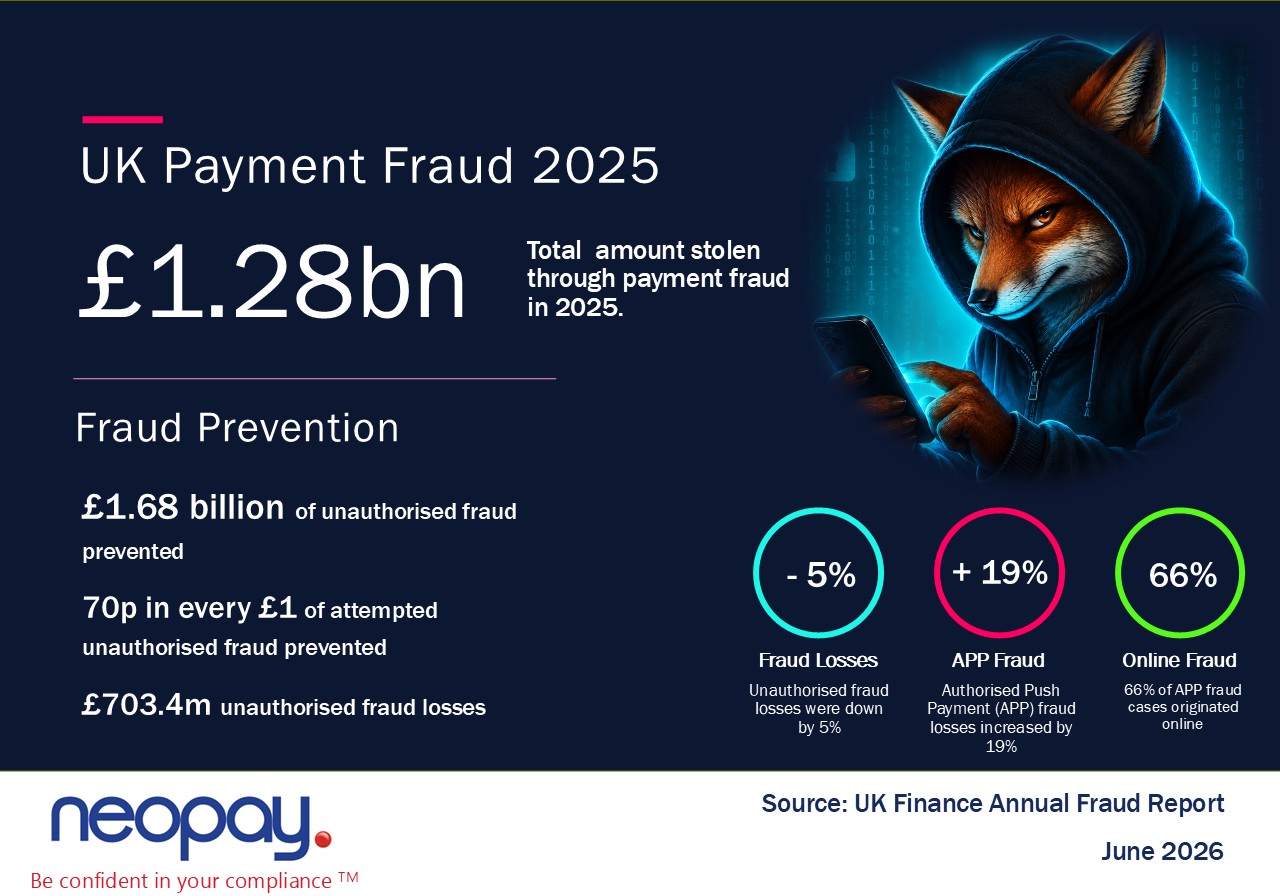
UK Finance has published its Annual Fraud Report 2026, revealing that criminals stole £1.28 billion through payment fraud in 2025, a four percent increase on the previous year.
Despite significant investment in fraud prevention and £1.68 billion in unauthorised fraud prevented, fraud remains a major threat to consumers, businesses, and the broader economy.
The report notes a shift in criminal tactics. While traditional fraud remains common, fraudsters are increasingly targeting scams that manipulate victims into authorising payments themselves.
Fraud cases reach record levels
In 2025, the report recorded over 4 million confirmed fraud cases, including 3.81 million unauthorised fraud cases and 248,070 Authorised Push Payment (APP) fraud cases. This marks an 11 percent increase from the previous year.
UK Finance reports that, on average, eight people were defrauded every minute in 2025, with nearly £2,500 stolen each minute.
These figures highlight the ongoing scale and persistence of fraud, despite continued investment in detection methods across the financial sector.
Banks continue to prevent significant losses
A positive finding from the report is the continued success of fraud prevention measures.
The industry prevented £1.68 billion of unauthorised fraud in 2025, meaning that approximately 70 pence of every £1 of attempted unauthorised fraud was stopped before any loss occurred.
Unauthorised fraud losses fell by five per cent to £703.4 million, despite more cases overall. This suggests firms are becoming more effective at detecting and preventing traditional fraud, even as attacks increase.
However, the same cannot be said for Authorised Push Payment (APP) fraud.
APP fraud continues to grow
APP fraud occurs when victims are persuaded to make payments to fraudsters, often believing they are dealing with a legitimate individual, business, or investment opportunity.
In 2025, APP fraud losses increased by 19 percent to £576.4 million, while case volumes rose seven percent to 248,070.
The data indicates that criminals are increasingly using social engineering tactics, exploiting trust and manipulating victims to authorise transactions themselves.
Unlike unauthorised fraud, which financial institutions can often detect and block, APP fraud is harder to prevent because customers willingly initiate the payments.
Investment fraud emerges as a major concern
The report identifies the continued growth of investment fraud as a significant concern.
Investment scams caused £221.5 million in losses in 2025, making them the largest APP fraud category by value. Losses rose 40 percent year-on-year, with case numbers up 26 percent.
Purchase scams remained a major issue, representing 71 percent of all APP fraud cases and resulting in £118.1 million in losses.
Meanwhile, romance fraud losses increased by 23 percent to £39.2 million.
These trends show that fraudsters are increasingly targeting victims through seemingly legitimate opportunities, often over extended periods before losses are detected.
The role of internet platforms and telecommunications
The report emphasises the ongoing role of online and telecommunications channels in facilitating fraud.
According to UK Finance:
- 66 percent of APP fraud cases originated online.
- 17 percent originated through telecommunications channels.
- Online fraud accounted for 32 percent of total APP losses.
- Telecommunications-related scams accounted for 28 percent of losses.
UK Finance is calling for stronger, enforceable obligations on technology companies, online marketplaces, and telecommunications providers.
Recommendations include enhanced controls on fraudulent advertising, mandatory seller verification for online marketplaces, secure payment mechanisms, and increased financial contributions from sectors whose platforms are exploited by criminals.
The report reinforces that tackling fraud requires a cross-sector approach, rather than relying solely on financial institutions.
Reimbursement remains important, but prevention is better
Victims of unauthorised fraud continue to benefit from strong legal protections, with banks refunding almost all unauthorised fraud losses.
The report also notes that banks reimbursed £354.3 million to victims of APP fraud during 2025, equivalent to 61 percent of total APP losses. Meanwhile, the Payment Systems Regulator has reported that 89 percent of in-scope APP fraud losses were reimbursed during the first 15 months of the reimbursement framework.
While reimbursement is an important protection, it does not stop funds from reaching organised criminals. Preventing fraud before payments are made remains the most effective solution for firms and customers.
What this means for firms
The UK Finance Annual Fraud Report 2026 shows that fraud continues to evolve.
Banks are more effective at preventing traditional unauthorised fraud, but criminals are shifting to scams that persuade victims to transfer money themselves.
With APP fraud losses at £576.4 million and investment fraud up 40 percent, firms should ensure their fraud prevention frameworks address current threats and adapt to emerging scam types.
The report highlights the importance of monitoring fraud risks originating outside the financial sector. As fraud increasingly begins on online platforms, social media, digital advertising, and telecommunications channels, effective prevention will require greater collaboration among financial institutions, technology firms, telecommunications providers, regulators, and law enforcement.
How Neopay can help
As fraud threats evolve, firms should regularly assess whether their fraud and financial crime frameworks remain effective, proportionate, and aligned with emerging risks.
Neopay supports payment firms, e-money institutions, fintechs, and other regulated businesses with fraud and financial crime audits, AML and framework reviews, risk assessments, training, and ongoing compliance support. Our team helps firms strengthen controls, identify gaps, and improve their ability to detect and prevent fraud.
If you would like to discuss your fraud prevention, AML, or financial crime controls, please contact Neopay to learn how we can help strengthen your framework.