
The regulatory landscape for payment firms is evolving rapidly. Firms must not only understand regulatory requirements but also demonstrate that their systems, controls, and processes operate effectively, from safeguarding and financial crime controls to governance and operational resilience.
Recent industry research suggests many firms are finding that increasingly difficult.
A survey of senior leaders across UK payment firms found that:
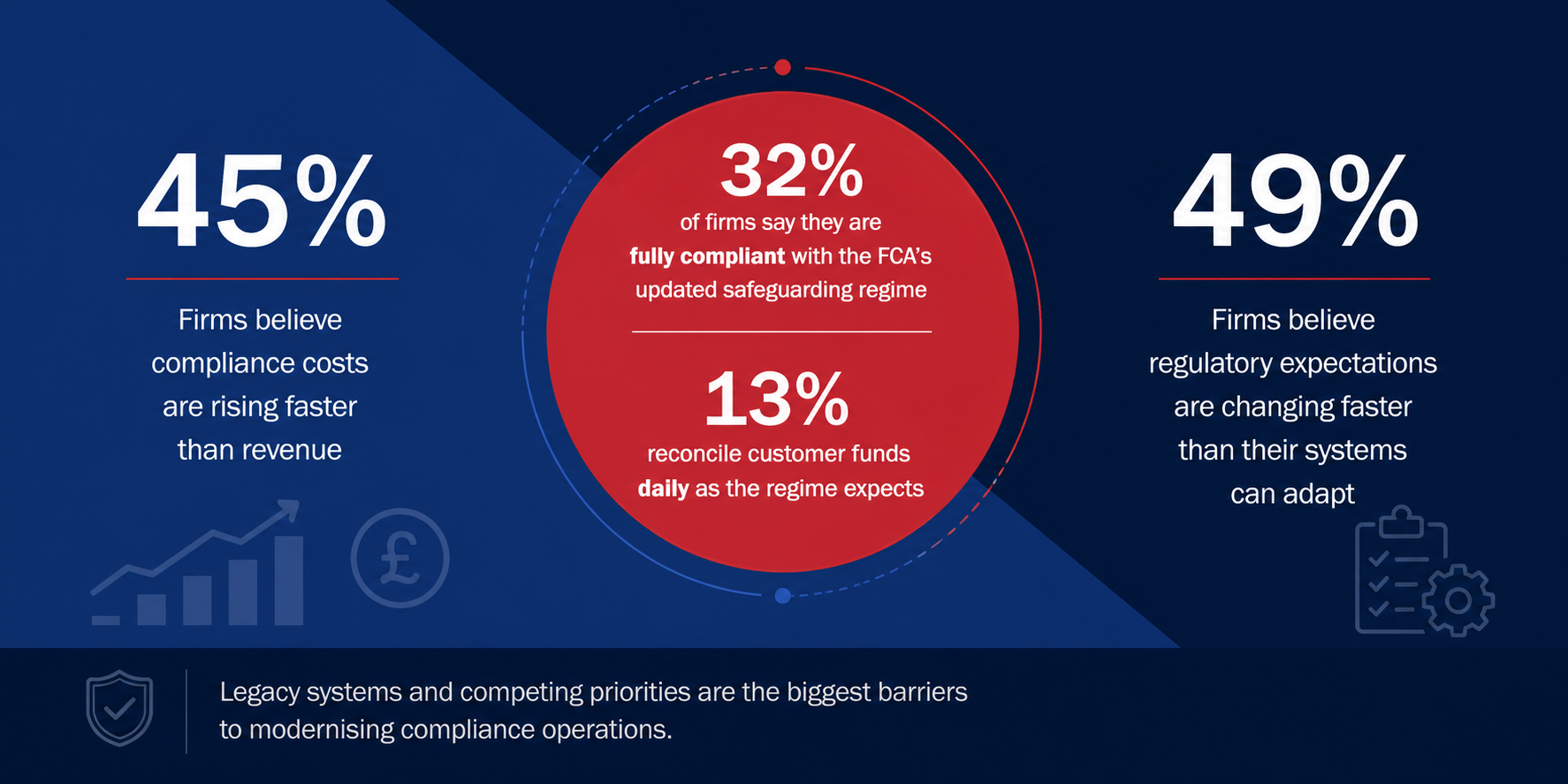
- 45% said compliance costs are increasing faster than revenue.
- 49% believe regulatory expectations are changing faster than their systems can adapt.
- Although 32% consider themselves fully compliant with the FCA’s updated safeguarding regime, only 13% reconcile customer funds daily in line with regulatory expectations.
- Legacy systems and competing business priorities were identified as the biggest barriers to modernising compliance operations.
These findings highlight an important shift. Compliance is no longer simply about interpreting regulation. Increasingly, firms must be able to evidence compliance through effective governance, operational controls, accurate reporting and reliable systems.
Regulation continues to raise the bar
Regulatory expectations for payment firms have increased significantly in recent years.
Firms are now expected to show that compliance is embedded throughout their organisation, not just in documented policies, whether responding to updated safeguarding requirements, strengthening financial crime controls, embedding Consumer Duty, or preparing for future regulatory developments.
As businesses expand, launch new products, and increase transaction volumes, many find that systems designed for growth are no longer sufficient to meet current regulatory expectations.
Compliance is becoming an operational challenge
Compliance now extends well beyond the compliance function.
It influences operations, finance, technology, product development, and senior management.
Manual reconciliations, spreadsheet-based processes, and disconnected systems may support early-stage businesses, but become difficult to maintain as organisations grow and regulatory scrutiny increases.
Many firms are investing in stronger governance, improved reporting, enhanced operational controls, and additional compliance expertise. However, introducing these measures reactively rather than as part of a long-term strategy can significantly increase operational costs.
Confidence doesn’t always reflect readiness
One of the most interesting findings from the research is the apparent gap between confidence and operational readiness.
Although nearly one-third of firms consider themselves fully compliant with the FCA’s updated safeguarding regime, far fewer conduct daily reconciliations as required by regulators.
This highlights an important distinction. Having policies and procedures is only one aspect of compliance. Regulators now expect firms to demonstrate effective controls in practice through accurate reconciliations, robust governance, effective oversight, reliable management information, and comprehensive record keeping.
Ultimately, compliance is measured not simply by what a firm says it does, but by what it can demonstrate.
Questions worth asking
As regulatory expectations evolve, firms should assess whether their compliance framework supports long-term growth or merely reacts to new regulatory developments.
Questions worth asking include:
- Are our compliance processes becoming increasingly manual?
- Can our systems produce the information regulators expect quickly and accurately?
- Do our governance arrangements provide meaningful oversight?
- Are our risk assessments evolving alongside the business?
- Are rising compliance costs the result of an inefficient operating model?
Proactively addressing these questions can help firms strengthen compliance and improve operational efficiency.
How Neopay can help
As regulatory expectations continue to evolve, payment firms need compliance frameworks that not only meet today’s requirements but can also adapt to future change.
Neopay supports payment firms with a range of compliance services, including safeguarding reviews, financial crime frameworks, independent audits, FCA authorisations, governance reviews and ongoing compliance support through our Virtual Compliance Service (VCS).
By combining effective governance, robust operational controls and the right expertise, firms can move beyond reactive compliance and build frameworks that support resilience, efficiency and sustainable growth.
If you’d like to discuss your compliance framework or regulatory obligations, contact Neopay to see how our consultants can support your business.