Summary
The costs of registering to become an SPI will vary depending on your size and business model, but you should expect to budget for the following.
What are the SPI registration costs?
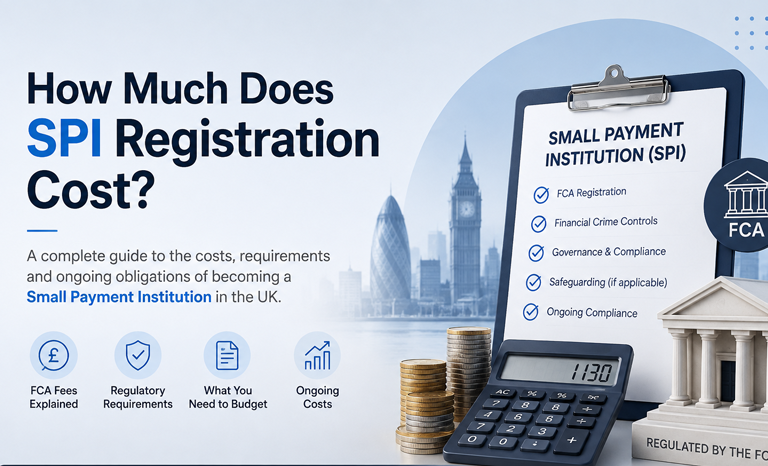
- FCA application fee of £1,130 https://www.fca.org.uk/firms/authorisation/apply/fees (Category 3)
- HMRC money laundering registration fee, if applicable, depends on business size and model.
- £300 money laundering registration fee plus
- £400 for each premises plus
- £400 per person.
https://www.gov.uk/guidance/money-laundering-regulations-registration-fees
Fees shown were correct at the time of publication. Firms should always check the latest FCA application fee schedule before submitting an application.
What additional costs should be considered in obtaining SPI registration?
SPI’s will incur additional costs prior to registration to ensure they meet regulatory requirements. These include:
- Recruiting required employees such as a Money Laundering Reporting Officer (MLRO), a suitable Compliance Team and Directors and Senior Managers
- UK Head Office
- Third party software fees e.g. KYC/KYB, Transaction Monitoring, sanctions, fraud detection etc.
- Legal fees e.g. for contracts and terms and conditions etc.
- FCA regulatory consultant for guidance, audit and review
https://www.fca.org.uk/firms/apply-emoney-payment-institution/pi
What other requirements are there for SPI registration?
Firms need to demonstrate to the FCA that they are well run and governed, with the appropriate controls and monitoring in place to give the FCA confidence in their compliance with regulation. This includes a suite of documentation showing how you operate including:
- Risk Assessments, procedures and methodology
- Risk Management
- Financial Crime and anti-money laundering controls and procedures
- Safeguarding of client funds (if applicable)
- Wind down planning
- Systems and security including incident reporting and data protection
- Governance and monitoring
- Auditing
https://www.fca.org.uk/firms/apply-emoney-payment-institution/pi
How much does it cost to register as a Small Payment Institution (SPI) with the FCA?
Introduction
The FCA application fee is only one part of the overall investment. Firms should also consider the time and resources needed to prepare regulatory documentation, establish appropriate governance arrangements, develop financial crime controls and maintain ongoing compliance.
This includes the costs of the appropriate Money Laundering Reporting Officer, additional compliance personnel and appropriate Board members as well as a UK Head Office. There will also be 3rd party costs for applications and services to meet regulations.
Before submitting an application, firms should always check the latest FCA fees and guidance, as fee schedules and regulatory requirements may change over time. The FCA publishes the latest fees on its Authorisation and Registration Application Fees page:
https://www.fca.org.uk/firms/authorisation/apply/fees
How much Is the FCA application fee?
At the time of writing, the standard FCA application fee for registering as a Small Payment Institution is £1,130. Where applicable, firms should also budget for the HMRC £300 money laundering registration fee, premises and person costs, and ongoing costs.
The FCA reviews its fees periodically, so firms should always check the latest Authorisation and Registration Application Fees before applying:
https://www.fca.org.uk/firms/authorisation/apply/fees
The application fee is separate from any annual FCA fees payable once a firm has been registered.
Is the FCA application fee the only cost?
No.
One of the biggest misconceptions is that registering as an SPI simply involves paying the FCA application fee and completing an application form.
In reality, the FCA expects firms to demonstrate that they are appropriately governed, well planned and capable of operating compliantly.
This includes demonstrating:
- Appropriate governance arrangements
- Experienced senior management and MLRO
- A realistic business plan
- Effective systems and controls
- Suitable compliance resources both internal and external
Preparing this documentation often represents a much larger investment than paying the application fee itself.
The FCA provides further guidance on what firms need to include in an application on its Apply to Become a Payment Institution or Electronic Money Institution page:
https://www.fca.org.uk/firms/apply-emoney-payment-institution
What other costs should firms budget for?
Every business is different, but firms commonly incur costs associated with:
- Developing a regulatory business plan
- Preparing a Programme of Operations
- Designing governance arrangements
- Producing financial crime policies and procedures
- Developing risk management frameworks
- Internal management time
- Third party software costs to meet regulatory requirements
- Legal fees for contracts, terms and conditions etc
- Professional compliance support, where appropriate
- Costs of premises, insurance and banking including safeguarding accounts where necessary
The exact cost depends on the complexity of the proposed business plan, how much of the operation is already in place, for example if you are already operating via a third party, and how much documentation has already been prepared.
Although these costs vary between firms, planning for them early can help avoid delays and reduce the likelihood of additional work during the FCA assessment process.
Why preparation matters
Preparing an SPI application involves considerably more than completing the FCA application forms.
A well-prepared application typically includes:
- Diagnostic analysis
- Planning workshops
- Regulatory business planning
- Risk management framework development
- Application pack preparation
- FCA liaison throughout the assessment process
Taking time to prepare a complete application can help identify gaps early, reduce delays and improve the quality of the final submission.
The FCA also provides guidance on the application process here:
https://www.fca.org.uk/firms/authorisation/apply
What are the ongoing costs?
Registration is only the beginning of a firm’s regulatory journey.
Businesses should also budget for ongoing costs associated with maintaining compliance, including:
- Annual FCA fees and other registration fees
- Compliance monitoring
- Financial crime reviews
- Audits including financial audits, financial crime and safeguarding
- Staff training
- Security costs
- Updating policies and procedures as the business evolves
- Third party software and other third party fees
Although SPIs are not subject to minimum capital requirements, firms should still ensure they have sufficient financial and operational resources to operate effectively and meet regulatory expectations.
A common mistake: focusing only on the FCA fee
Many firms begin by asking:
“How much is the FCA application fee?”
A better question is:
“What will it cost to become ready for FCA registration?”
The application fee is only a small part of the overall process. Developing the documentation, governance arrangements and compliance framework needed to support a successful application often requires considerably more time and resource than paying the fee itself.
Planning for these requirements from the outset can help reduce delays and improve the likelihood of a smoother application process.
How Neopay can help
Preparing an SPI application involves much more than completing forms.
Neopay supports firms throughout the registration process, from initial planning and diagnostic reviews through to documentation, application preparation and FCA engagement.
Our consultants help businesses develop practical, proportionate compliance frameworks that meet FCA expectations while supporting their long-term objectives. If you’re considering SPI registration and would like to discuss your application or the support you may need, contact Neopay to speak with one of our regulatory consultants.
Frequently Asked Questions
How long does SPI registration take?
The FCA generally aims to determine complete applications within the statutory timeframe.
However, if an application is incomplete or further information is required, the process may take longer.
Further information about the application process is available on the FCA website
Do SPIs need minimum capital?
No. Unlike Authorised Payment Institutions (APIs) and Authorised Electronic Money Institutions (AEMIs),
SPIs are not subject to minimum capital requirements.
Can I prepare an SPI application myself?
Yes. There is no requirement to use a consultant. However, many firms choose specialist support because
preparing a robust application requires significant planning, documentation and engagement with the FCA.
Where can I find the latest FCA fees?
The FCA publishes the latest application fees and guidance on its website.
Useful resources include: